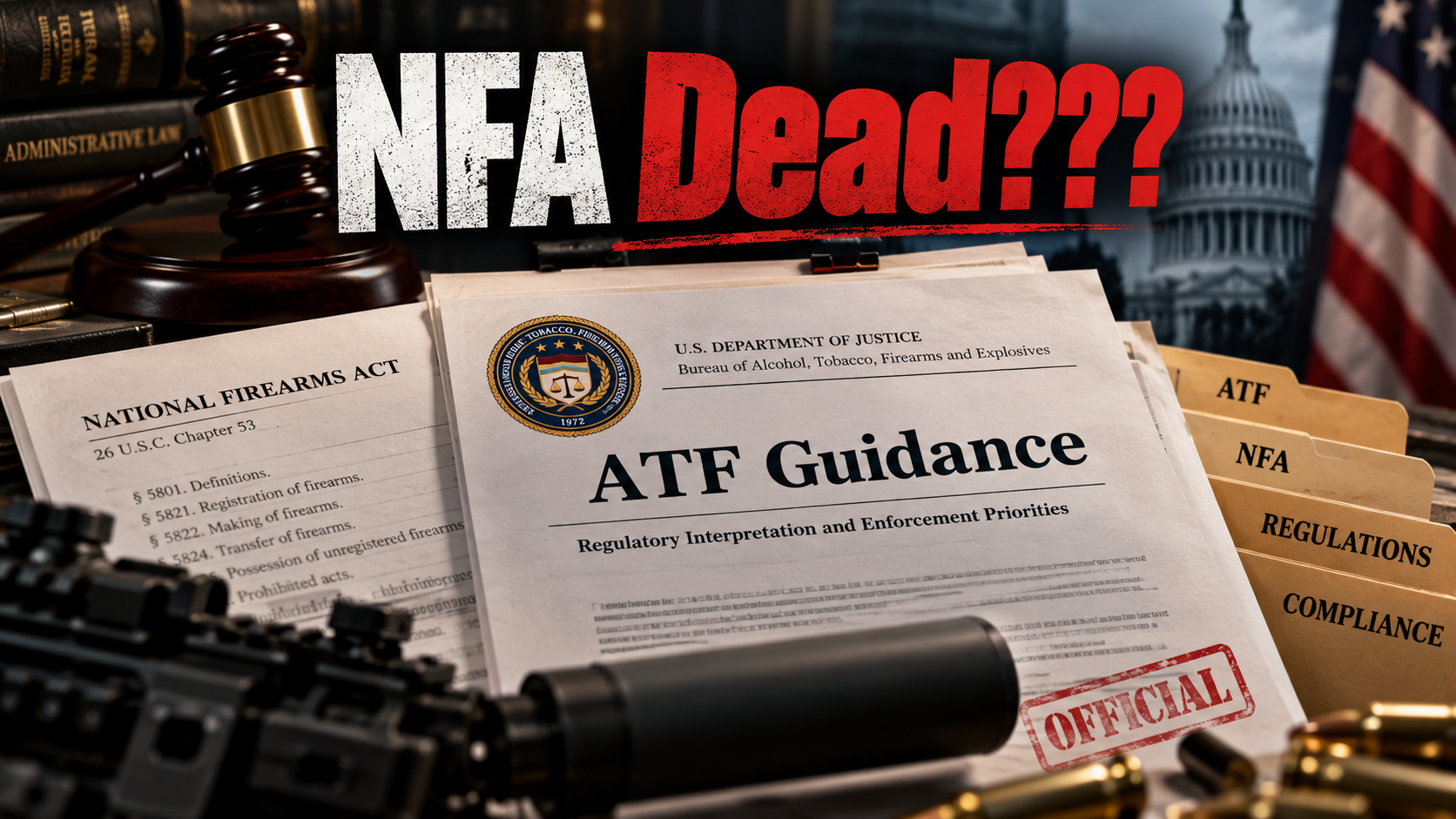
ATF Announces Nationwide Change in National Firearms Act Enforcement Following Federal Court Ruling

October 9 guidance changes federal enforcement of registration and approval requirements for suppressors, short-barreled rifles, short-barreled shotguns, and certain other firearms. Important federal restrictions and state laws remain in place.
Reporting Key: Blue — Reporting
On October 9, 2026, the Bureau of Alcohol, Tobacco, Firearms and Explosives (ATF) issued formal guidance announcing that it would stop enforcing several provisions of the National Firearms Act (NFA) nationwide. The announcement affects suppressors, short-barreled rifles, short-barreled shotguns, and a federally defined category of concealable firearms known as “any other weapons” (AOWs). The decision follows a federal court ruling in Texas that challenged the continued application of certain NFA requirements after Congress reduced the making and transfer taxes on those items to zero.
The change is substantial. For the four affected categories, the ATF announced that it would no longer enforce federal requirements for advance approval before making or transferring covered items, mandatory NFA registration, or several related provisions. The Department of Justice also decided to extend the policy nationwide, even though the underlying court injunction protected only the plaintiffs and certain individuals and entities associated with them. The announcement does not repeal the NFA, eliminate federal firearms laws, or override state and local restrictions.
The distinction between what Congress changed, what the court decided, and what the Justice Department subsequently announced is essential to understanding the October 9 guidance. Each action has a different legal basis, and the ATF’s published documents expressly acknowledge limitations that could otherwise be overlooked.
Key Points
- ATF announced a nationwide policy of nonenforcement for specified NFA approval, registration, and related requirements covering suppressors, short-barreled rifles, short-barreled shotguns, and certain other weapons.
- The underlying statutes have not been repealed. Other federal firearms restrictions, including applicable Gun Control Act requirements, remain in effect.
- State and local laws still apply and may contain registration or federal-compliance conditions.
- The ATF will continue accepting voluntary NFA registrations and applications. The agency says the federal enforcement policy may change.
The Legislative Change That Started the Dispute
The National Firearms Act was enacted in 1934, establishing federal taxation, registration, and transfer requirements for certain firearms and devices. Its original framework included taxation of covered firearms and administrative requirements designed to support the collection and enforcement of those taxes. For decades, the familiar $200 making or transfer tax was associated with many NFA firearms, including suppressors and short-barreled rifles. An additional tax structure applied to some items categorized as AOWs.
In 2025, Congress enacted the One Big Beautiful Bill Act, Public Law 119-21, which reduced the making and transfer taxes on four NFA categories to $0, effective January 1, 2026. Those categories included suppressors, short-barreled rifles, short-barreled shotguns, and AOWs as defined in 26 U.S.C. § 5845(e). Congress did not eliminate the $200 tax on machine guns or destructive devices. The legislation also did not expressly repeal the NFA’s registration system or the various statutory requirements that had accompanied the collection of those taxes.
That distinction created the central issue in the subsequent litigation. The plaintiffs challenged whether the federal government could continue enforcing the NFA’s registration and approval provisions against firearms whose making and transfer taxes Congress had reduced to zero. The argument concerned the constitutional authority supporting those requirements, particularly the federal government’s taxing power, rather than a general claim that all federal firearms regulation was unconstitutional.
The August 5 Federal Court Ruling
On August 5, 2026, U.S. District Judge James Wesley Hendrix, sitting in the Northern District of Texas, issued a ruling in Silencer Shop Foundation v. Bureau of Alcohol, Tobacco, Firearms and Explosives, Case No. 6:25-cv-00056. The court concluded that the challenged making, registration, and transfer provisions could no longer be justified under Congress’s taxing power when applied to the four categories for which Congress had eliminated the applicable taxes. The court also rejected the government’s alternative reliance on the Commerce Clause in this litigation, reasoning that Congress had not relied on its interstate commerce authority when originally enacting the NFA in 1934.
The court granted a permanent injunction against enforcement of the challenged provisions for the plaintiffs and, where applicable, their agencies, political subdivisions, members, and current or future customers. It did not issue a blanket nationwide injunction protecting every person or entity. The judge also denied some requested relief, and the injunction did not cover every provision of the NFA. The order was stayed for seven days, with the ATF subsequently identifying August 12 as its effective date.
That limitation matters because the August ruling and the October announcement accomplished different things. The court restricted enforcement against specified parties through a judicial order. The Justice Department subsequently adopted a broader administrative policy concerning enforcement against people who were not protected by that order. The difference between a judicial injunction and an executive branch enforcement decision remains relevant even when their immediate practical effects overlap.
The October 9 Announcement Extends the Policy Nationwide
Following the ruling, the ATF reported receiving requests for clarification from litigants, members of Congress, state attorneys general, industry representatives, and members of the public. According to the agency’s October 9 open letter, 47 members of the U.S. House and Senate had requested nationwide application of the ruling. The letter specifically referenced correspondence dated August 11, 2026, led by Representative Andrew Clyde.
Attorney General Todd Blanche announced that the Department of Justice would not appeal the August decision and would instead exercise its enforcement discretion to extend the new policy beyond those specifically protected by the injunction. The ATF subsequently released a three-page open letter signed by Director Robert Cekada, accompanied by a press release and a detailed collection of frequently asked questions. The policy became effective October 9, 2026.
The ATF’s explanation identifies greater uniformity as a reason for the broader decision. Without the nationwide policy, the court’s injunction would have restricted enforcement against certain plaintiffs and associated persons while leaving others outside its protection. The Justice Department chose to apply the nonenforcement policy to everyone otherwise subject to the specified NFA requirements, regardless of whether they participated in the litigation.
Which National Firearms Act Requirements Are Affected?
The ATF’s October 9 guidance identifies specific NFA provisions it will no longer enforce against the four affected categories. The changes concern more than the $200 tax, which Congress had already reduced to zero. They address the approval and registration requirements that remained after the tax legislation took effect.
According to the agency’s published FAQs, the federal nonenforcement policy covers:
- The requirement to apply for and receive advance ATF approval before making covered NFA firearms.
- The requirement to apply for and receive advance ATF approval before transferring covered NFA firearms.
- The requirement to register covered firearms in the National Firearms Registration and Transfer Record (NFRTR).
- The requirement for those engaged in the business to register covered NFA firearms within 24 hours of making them.
- Various NFA prohibitions concerning the making, receipt, transfer, and possession of unregistered covered firearms, subject to expressly stated exceptions.
- The NFA prohibition against transporting unregistered covered firearms in interstate commerce under 26 U.S.C. § 5861(j).
- The NFA’s marking requirements for covered firearms.
- Other NFA provisions specifically included in the district court’s judgment.
The ATF makes clear that not every criminal provision disappears from enforcement. The agency expressly excludes 26 U.S.C. § 5861(h) and (k), which concern firearms with unlawfully altered or obliterated serial numbers and firearms imported in violation of applicable requirements. The guidance also distinguishes the NFA’s marking provisions from separate federal requirements that continue to apply to licensed manufacturers, including serialization requirements under the Gun Control Act.
These changes constitute an announced policy of federal nonenforcement. They are not equivalent to Congress deleting the affected provisions from the United States Code, and the ATF does not describe them as a complete elimination of federal oversight.
Federal Firearms Requirements That Remain in Effect
Although the agency is changing its NFA enforcement approach, the Gun Control Act of 1968 (GCA) remains applicable. The ATF explains that the affected firearms and devices continue to qualify as firearms under federal law, including suppressors, which have a specific statutory status under the GCA. Consequently, the October 9 announcement does not eliminate restrictions on possession by prohibited persons, federal dealer recordkeeping requirements, or applicable background checks.
Federal firearms licensees must continue completing ATF Form 4473 when required, conducting National Instant Criminal Background Check System (NICS) checks unless a recognized exception applies, and maintaining the records required by federal law. Interstate transactions and transfers to prohibited persons remain subject to the Gun Control Act’s restrictions. The ATF also explains that unlicensed individuals remain subject to federal limitations on engaging in the business of manufacturing or dealing in firearms.
Machine guns and destructive devices are outside the four categories receiving the new nonenforcement treatment. Congress retained their $200 NFA making and transfer taxes, and the ATF states that the NFA continues to apply to those categories in full. Likewise, Congress did not repeal the special occupational taxes imposed on businesses engaged in manufacturing, importing, or dealing in NFA firearms. Those business taxes continue to apply, including to businesses dealing in the four newly untaxed categories.
An Additional Issue for Short-Barreled Rifles and Shotguns
The ATF’s guidance identifies a separate issue involving licensed dealer transfers of short-barreled rifles and short-barreled shotguns. Under 18 U.S.C. § 922(b)(4), the Gun Control Act restricts federal firearms licensees from selling or delivering these firearms without specific authorization from the Attorney General. Historically, the NFA approval process also served as the mechanism for satisfying that GCA requirement.
With NFA approval no longer being enforced under the new policy, the ATF acknowledges that no alternative regulatory approval mechanism currently exists for these transfers. The agency states that it is developing new forms and regulations to address the gap. Until those regulations are established, the ATF has announced that it will also decline to enforce § 922(b)(4). That separate decision is significant because the Texas court did not invalidate or enjoin the relevant Gun Control Act provision.
The ATF also distinguishes transfers from interstate transportation. The agency states that the Gun Control Act requirement for prior approval before transporting short-barreled rifles and short-barreled shotguns across state lines remains in effect under 18 U.S.C. § 922(a)(4). The agency identifies ATF Form 5320.20, commonly called Form 20, as the continuing approval process, even when the firearm is not registered under the NFA. This is different from the separate NFA provision under § 5861(j), which the Justice Department has elected not to enforce for the newly untaxed categories.
The Federal Registration System Is Not Being Abolished
One of the less obvious details in the October 9 announcement concerns the future of the National Firearms Registration and Transfer Record. Although the ATF is no longer enforcing registration requirements for the affected categories, the agency expressly states that it will continue maintaining the registry and processing voluntary applications. The existing system therefore remains operational, even as enforcement changes for qualifying firearms and devices.
The open letter identifies several forms that will continue to be accepted. Form 1 concerns applications to make and register firearms, while Forms 3 and 4 concern transfers and registration. Manufacturers may also continue reporting the making of covered items through Form 2. The agency explains that maintaining voluntary registration is particularly relevant because some states have laws that refer to federal NFA registration or approval. In those jurisdictions, the new federal policy does not necessarily resolve whether an unregistered firearm satisfies state requirements.
The ATF also addresses the removal of previously registered firearms from the federal registry. Its FAQs explain that individuals may request removal through the NFA Division, but caution that an item removed from registration cannot ordinarily be registered again unless the Attorney General declares an amnesty. The agency has not announced a general amnesty, automatic re-registration program, or elimination of existing registry records.
State and Local Laws Are Not Changed by the Announcement
The ATF’s open letter specifically identifies state and local firearms laws as one of the principal limitations of its new enforcement policy. The federal announcement does not invalidate state restrictions on suppressors, short-barreled rifles, short-barreled shotguns, or other NFA firearms. Some jurisdictions have independent prohibitions, while others recognize exceptions tied to compliance with federal law or registration under the NFA.
Those differences create questions the ATF expressly declines to resolve. In its published FAQs, the agency acknowledges that it cannot determine whether an unregistered firearm possessed under the federal court injunction or the Justice Department’s enforcement discretion necessarily satisfies a particular state’s laws. A state may have statutory language requiring federal registration, compliance with federal law, or some other condition that must be evaluated separately. The agency also notes that licensed dealers remain prohibited under the Gun Control Act from transferring covered firearms in violation of applicable state or local restrictions.
Interstate travel presents another distinction. The ATF’s letter discusses 18 U.S.C. § 926A, a federal provision concerning interstate transportation of firearms, and acknowledges uncertainty about how state courts might apply its protections to unregistered NFA items. The agency does not promise that the new federal enforcement policy will provide protection against state-level enforcement during travel through jurisdictions with different firearms restrictions.
The October 9 documents do not provide a comprehensive, state-by-state determination of how the policy interacts with every jurisdiction’s laws. Readers seeking information about particular circumstances should consult a qualified attorney familiar with their state’s firearms statutes, review guidance from their state attorney general’s office, or contact the appropriate state and local authorities. This report does not offer legal advice, determine the legality of any particular firearm or transaction, or recommend changes to an individual’s registration status.
Could the Federal Enforcement Policy Change Again?
The ATF’s accompanying FAQs address the possibility that the current federal enforcement position could change. The agency identifies several circumstances that could alter the legal or administrative situation, including congressional action imposing new taxes, a change in the status of the court injunction, or a Justice Department decision to withdraw the announced enforcement policy.
Those possibilities are discussed in the agency’s own guidance, rather than being predictions about future government action. The ATF explains that existing federal law generally does not provide automatic grandfathering for unregistered NFA firearms if circumstances change. It also notes that federal law ordinarily does not allow later registration of previously unregistered NFA items, apart from limited statutory mechanisms such as an amnesty declared by the Attorney General.
That portion of the FAQs is particularly relevant to the distinction between an existing federal statute and a decision not to enforce portions of it. The ATF identifies felony penalties and forfeiture provisions that remain in the NFA and describes circumstances under which enforcement could resume. The published guidance does not establish a permanent statutory exemption for all future circumstances, nor does it promise a future registration opportunity if the present policy changes.
A Significant Result for the Plaintiffs and Second Amendment Organizations
The outcome represents a substantial result for the plaintiffs in Silencer Shop Foundation v. ATF. Their challenge produced a permanent federal injunction against enforcement of specified NFA provisions for the protected parties, followed by a Justice Department decision not to appeal and a separate nationwide nonenforcement policy. The October announcement extends the practical reach of that result beyond the parties who originally brought the litigation.
For the plaintiffs and Second Amendment advocates who have sought changes to federal restrictions on suppressors and short-barreled firearms, the outcome represents a significant victory for their position. The underlying developments are documented by the court’s decision, the Justice Department’s announcement, and the ATF’s published guidance. Describing the outcome as a victory for those who pursued it does not require concluding that every disputed legal question has been permanently resolved.
The October 9 announcement is also distinct from the earlier congressional tax reduction. Congress eliminated the applicable making and transfer taxes in 2025, the district court issued its injunction in August 2026, and the Justice Department adopted its nationwide enforcement policy in October. Those are three separate government actions, each contributing to the current situation.
What the October 9 Documents Establish
The ATF has announced that it will no longer enforce specified National Firearms Act approval, registration, and related requirements for four categories of firearms and devices whose making and transfer taxes Congress reduced to zero. The agency has extended that policy nationwide through the Justice Department’s enforcement discretion, notwithstanding the narrower scope of the federal court’s injunction.
The same documents confirm that the NFA remains in effect, that machine guns and destructive devices remain subject to its existing requirements, and that the Gun Control Act continues to regulate firearms transactions. Federal registration remains available on a voluntary basis, occupational taxes continue for qualifying businesses, and independent state and local restrictions are unaffected.
The original ATF open letter, court ruling, and accompanying FAQs provide the details necessary to distinguish the scope of the federal announcement from claims that the National Firearms Act has been repealed or that all firearms previously covered by it are now free of regulation.
Original Documents and Primary Sources
The original three-page ATF open letter of October 9, 2026 (PDF), signed by ATF Director Robert Cekada, sets out the nationwide policy and its limitations. Readers can also consult the ATF guidance and frequently asked questions for detailed explanations of the covered provisions, state laws, interstate transportation, and registration.
Additional primary records include the August 5, 2026 federal court opinion in Silencer Shop Foundation v. ATF and the ATF’s October 9 press release.


