Before You Click: Stop, Wait, and Protect Your Money

The internet makes shopping easier than ever. It also makes it easier to buy things we don’t need, trust people we shouldn’t, and give away information without realizing what we’re getting in return.
Americans reported losing nearly $21 billion to internet crime in 2025, according to the FBI. More than $7.7 billion of those losses were reported by people over the age of 60. Those figures include many kinds of internet crime, not just fraudulent shopping websites, but they reveal how costly online fraud has become. Source: FBI, 2025 Internet Crime Report (PDF).
The Federal Trade Commission reported another staggering figure: $2.1 billion in losses from scams that began on social media in 2025. Shopping scams were the most frequently reported type. Consumers ordered clothing, cosmetics, household gadgets, and other merchandise after seeing advertisements, only to discover that products never arrived or were nothing like what they expected. Source: FTC, April 2026.
Even those numbers don’t tell the whole story. How much money do Americans spend every year on products that turn out to be poorly made, practically useless, or completely unnecessary? Think about the $25 Temu order that arrives with merchandise so flimsy it breaks after a few uses. Or the kitchen gadget that looked wonderful in a TikTok demonstration but ends up in a drawer after one disappointing attempt.
Most people aren’t going to report those purchases as fraud. Many won’t bother returning the merchandise, particularly when the amount is small. They accept the loss and move on. We don’t have a reliable national figure for all that wasted spending, but every disappointing $10, $25, or $50 purchase still comes out of somebody’s pocket. When those amounts accumulate, they can become substantial.
There was a time when shopping meant visiting a store, examining something on a shelf, and deciding whether it was worth the asking price. You could hold it, compare it with alternatives, and ask questions. If it broke, you generally knew where to take it back. Today you can purchase almost anything without leaving your chair. That’s particularly useful for specialized hobbies, older equipment, and hard-to-find replacement parts. Ask someone where they found an unusual gardening accessory, automotive component, or model railroad part, and there’s a good chance the answer will be Amazon.
But convenience has changed something else. You can be reading the news, checking Facebook, watching TikTok, or researching a vacation when an advertisement introduces you to something you never intended to buy. Five minutes later, you’re seriously considering spending $59 on a product you didn’t know existed when you woke up.
The internet has become one enormous checkout lane for spontaneous purchases. Unlike the candy bars and magazines beside the grocery store register, this checkout lane follows us almost everywhere we go.
This article is especially important for older Americans and the people who help them manage their finances, although none of these problems is exclusive to seniors. Age doesn’t make someone incapable of recognizing a scam, just as youth doesn’t make someone immune to one. What matters is understanding how these techniques work and developing habits that help protect your money. The goal isn’t to make you afraid of every advertisement or online store. It’s to help you recognize when someone is making the purchasing decision a little too easy.
The First Rule: Stop and Wait
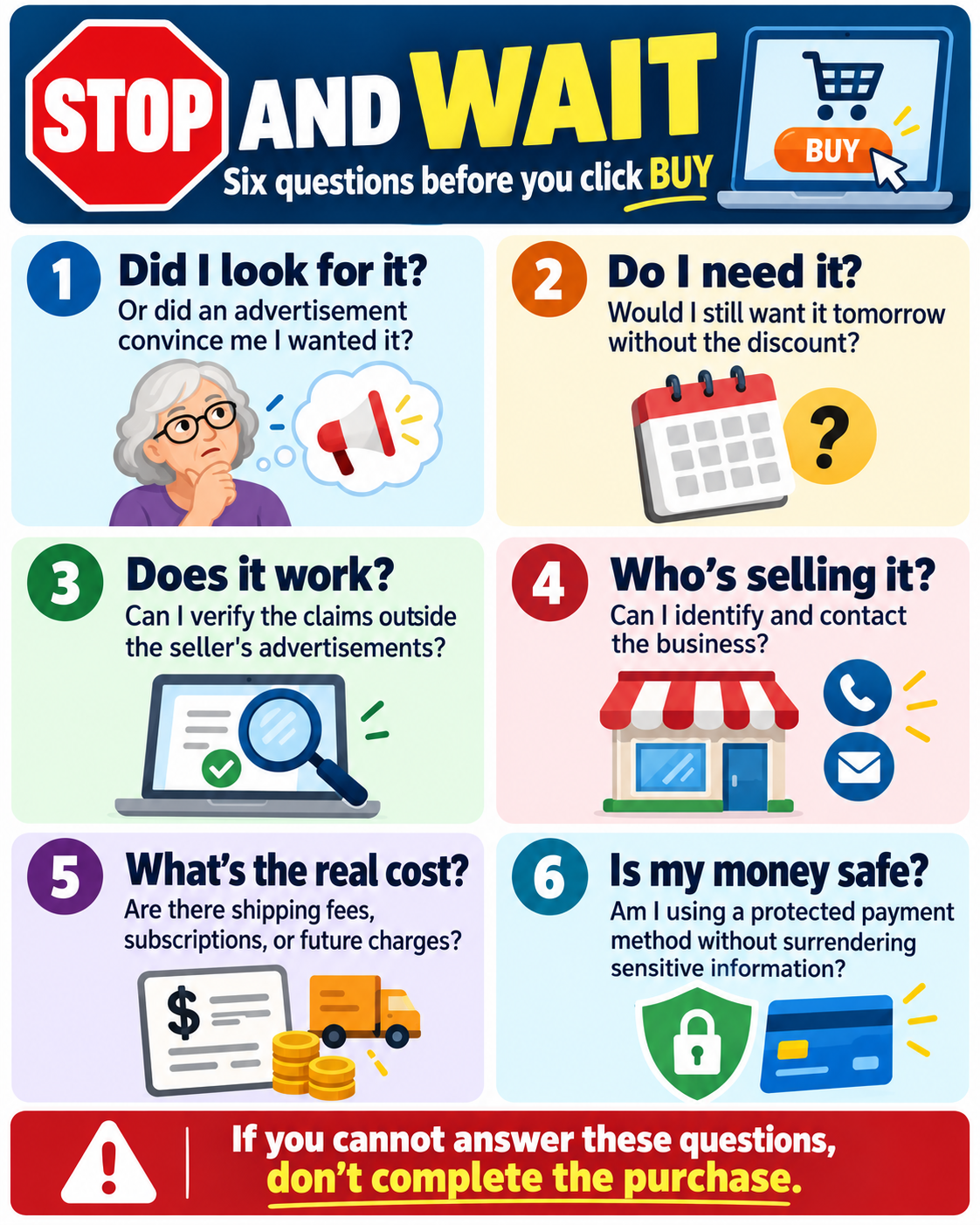
Before worrying about whether a website is legitimate or whether the price is a bargain, ask yourself a more basic question: Why am I thinking about buying this?
Suppose you’re watching a video demonstrating a remarkable kitchen appliance. It chops vegetables, slices fruit, and supposedly replaces half the utensils you already own. The demonstration is impressive, and the seller promises a discount if you order within ten minutes. Suddenly, you’re imagining how useful it would be, even though everything in your kitchen works perfectly well. The advertisement has accomplished two things: it has made you want something you weren’t looking for, and it has given you a deadline.
Neither is a good reason to buy. Close the advertisement and go about your day. If you still want the appliance tomorrow, look it up independently, compare prices, and see what other buyers have to say. If you’ve forgotten about it by then, that may tell you how much you actually needed it.
Of course, you don’t have to wait a day before ordering a replacement part you’ve spent a week trying to find. There’s a difference between deliberately shopping for something you need and making a purchase because an advertisement caught your attention. The question is whether you started the shopping trip or the advertiser started it for you.
Before you click Buy, stop long enough to decide whether this is something you genuinely want, something you actually need, and something worth the money you’re about to spend.
Why You’re Suddenly Seeing Advertisements for Toasters
Suppose your toaster has been acting up. One morning, you search Google to see what a replacement might cost. You look at several models, compare prices, and decide to keep using the one you already have. Later, you open Facebook and see an advertisement for a toaster. Then another. Over the next few days, toasters seem to appear everywhere.
Eventually, you might begin wondering whether you should replace yours after all. When something has already been on our minds, repeatedly encountering it can feel strangely meaningful. Some people even take the sudden appearance of related advertisements as a sign that they’re supposed to buy the product. Usually, there’s a much more ordinary explanation: advertising systems have identified something that interests you.
Search engines, social media platforms, and participating websites use information such as searches, browsing activity, video views, and interactions with advertisements to select what you see next. Cookies and tracking pixels can contribute, and businesses pay to reach people they believe might buy their products. Not every advertisement comes from tracking an individual; some depend on the page you’re viewing, general location, or other factors. But personalized advertising is a major part of the online marketplace.
The same thing can happen when you research an expensive automotive repair. Before long, you may see advertisements for replacement vehicles, financing, warranties, and dealerships. The advertising may be relevant, but relevance isn’t the same as good advice. Seeing repeated ads for a toaster doesn’t mean yours needs replacing. Seeing ads for new cars doesn’t mean repairing your old one is a mistake.
You can review personalized advertising preferences through Google My Ad Center and the advertising settings available on Facebook and Instagram. Browser privacy controls may also limit certain tracking. The important lesson is simple: An advertisement may know what interests you. That doesn’t mean it knows what’s best for you.
Rewards Cards: Are You Saving Money or Being Encouraged to Spend More?
Most of us have a collection of rewards cards, whether physical cards, phone numbers entered at checkout, or accounts connected to store applications. Grocery stores offer fuel points, pharmacies provide coupons, and retailers promise special discounts just for being a member. Those savings can be worthwhile, especially at stores where you regularly shop. But have you considered what the retailer gets from the arrangement?
Every time you use a rewards account, a retailer can associate purchases with you. Over time, it may learn which brands you prefer, how frequently you shop, and which promotions influence your choices. That information can help determine which coupons and advertisements to send you. Suppose you buy ice cream on impulse a couple of times. Soon you may begin seeing discounts for ice cream and similar products. The offer feels helpful because it’s for something you enjoy, but it may also encourage another purchase you weren’t planning to make. Your own shopping history has helped the store determine what might tempt you next.
Fuel rewards provide another interesting example. Grocery stores sometimes encourage customers to accumulate points for discounts at participating gas stations. Saving ten cents per gallon sounds worthwhile, especially when gasoline is expensive, but consider what it actually means: on a 12-gallon fill-up, ten cents off saves $1.20. On 15 gallons, it saves $1.50.
Now imagine buying an additional $20 worth of groceries you didn’t need just to earn the discount. You’ve spent considerably more than you saved at the pump. Of course, if you earned the points buying groceries you already needed at competitive prices, enjoy the savings. The problem begins when the reward changes your spending decisions.
That’s the psychological appeal of these programs. We see points accumulating, watch our progress toward the next reward, and sometimes spend more because we’re reluctant to miss out on something we’ve almost earned. There’s nothing wrong with using rewards cards, but a program offered at no charge can still give the business valuable information about your habits and another opportunity to encourage spending.
Before signing up for another program or buying something to earn points, ask yourself: Would I buy this without the reward, and how many actual dollars am I saving?
Find the Company Before You Buy the Product
One of the biggest differences between shopping at a physical store and shopping online is knowing who’s taking your money. At your local hardware store, you can see the business, speak with an employee, and return if there’s a problem. Online, you may be dealing with a company thousands of miles away through a website you’ve never visited.
Professional-looking websites are easy to create. Product photographs, customer testimonials, official-looking badges, and five-star ratings don’t prove that a business is trustworthy. Even the padlock beside a website address means only that your connection is encrypted; it doesn’t establish the honesty of the person receiving your money.
Before purchasing from an unfamiliar business, identify who’s behind it. Look for a verifiable business name, physical address, working telephone number or customer-service contact, and a clear return policy. Search independently for reviews, complaints, and refund experiences rather than depending only on testimonials on the seller’s own site. Don’t merely locate contact information; consider testing it before an expensive purchase. Ask where the product ships from, whether it’s in stock, or how warranty claims work.
If an address doesn’t check out, the return instructions make no sense, or nobody responds to reasonable questions, you’ve learned something important without risking your money. If you can’t find the company before the sale, don’t count on finding it afterward.
Miracle Products and the Things You Never Knew You Needed
Anyone who spends time on social media has probably encountered products promising astonishing results. A toothpaste supposedly removes years of stains in minutes. A serum restores a full head of hair in thirty days. A supplement melts away pounds while you sleep. A cleaning gadget outperforms expensive professional equipment, and a cream makes wrinkles disappear almost instantly.
The demonstrations can be convincing. Sometimes a person dressed like a medical professional explains the supposed science. Other times an influencer displays dramatic before-and-after photographs. Before accepting the claims, consider what you’re being asked to believe. If a $29 hair treatment reliably restored a full head of hair in a month, that would be a significant development. There should be independent evidence supporting the result, not merely photographs and testimonials supplied by the seller.
Words such as “clinically tested,” “scientifically formulated,” and “doctor recommended” aren’t proof by themselves. Another warning sign is a supposedly revolutionary item available only through the website advertising it. Search for the actual manufacturer and independent product information. You may discover identical-looking merchandise sold under several names, each promoted as an exclusive invention.
Be particularly cautious when a seller claims that experts or major companies are hiding the discovery from the public. That story may make an advertisement exciting, but it isn’t evidence. Sometimes the product doesn’t perform as promised; sometimes it’s a cheap imitation; and sometimes no meaningful product exists behind the advertisement at all.
Read the Fine Print Before It Becomes Your Problem
Advertisers make it easy to understand why they want you to buy. Benefits appear in large letters, enthusiastic demonstrations, and confident promises. Limitations may require more effort to find. An advertisement might proclaim a remarkable result while showing “results not typical” in small print. A service might cost “as little as $19 per month” only under conditions the consumer hasn’t examined, while an “up to 80%” discount may apply to a handful of items.
Pay attention to phrases such as “additional charges may apply,” “automatic renewal,” “individual results may vary,” and “subject to terms and conditions.” The fine print may contain the most important details in the offer. This becomes particularly important when a website asks you to agree to marketing permissions, future deliveries, or recurring charges. A box already checked may be authorizing something you didn’t intend.
You don’t need to become a lawyer to shop online. But if the exciting promise is easy to understand and the financial obligations are strangely difficult to find, that’s a good reason to reconsider.
The Free Quote That Turns You Into a Sales Lead
You see an advertisement promising affordable life insurance. You’re curious, so you click and answer a few questions. Everything seems reasonable until the website demands your name, telephone number, and email address before providing a price. You enter the information expecting a quote. Then your phone rings.
In some lead-generation arrangements, calls can begin almost immediately. Additional salespeople may contact you afterward, sometimes repeatedly. The site may not have belonged to an insurer at all, but to a business collecting information and sending it to companies hoping to sell you something. Similar arrangements appear in advertising for home improvement, warranties, debt relief, and other services.
There’s nothing inherently wrong with connecting interested customers to service providers. The problem arises when a consumer doesn’t realize that requesting information may mean inviting multiple businesses to contact them. Look for language about participating partners or providers. If you simply want to investigate a price, consider approaching an established company directly. You shouldn’t have to become somebody’s marketing lead just to satisfy your curiosity.
“Act Now!” Isn’t a Financial Emergency
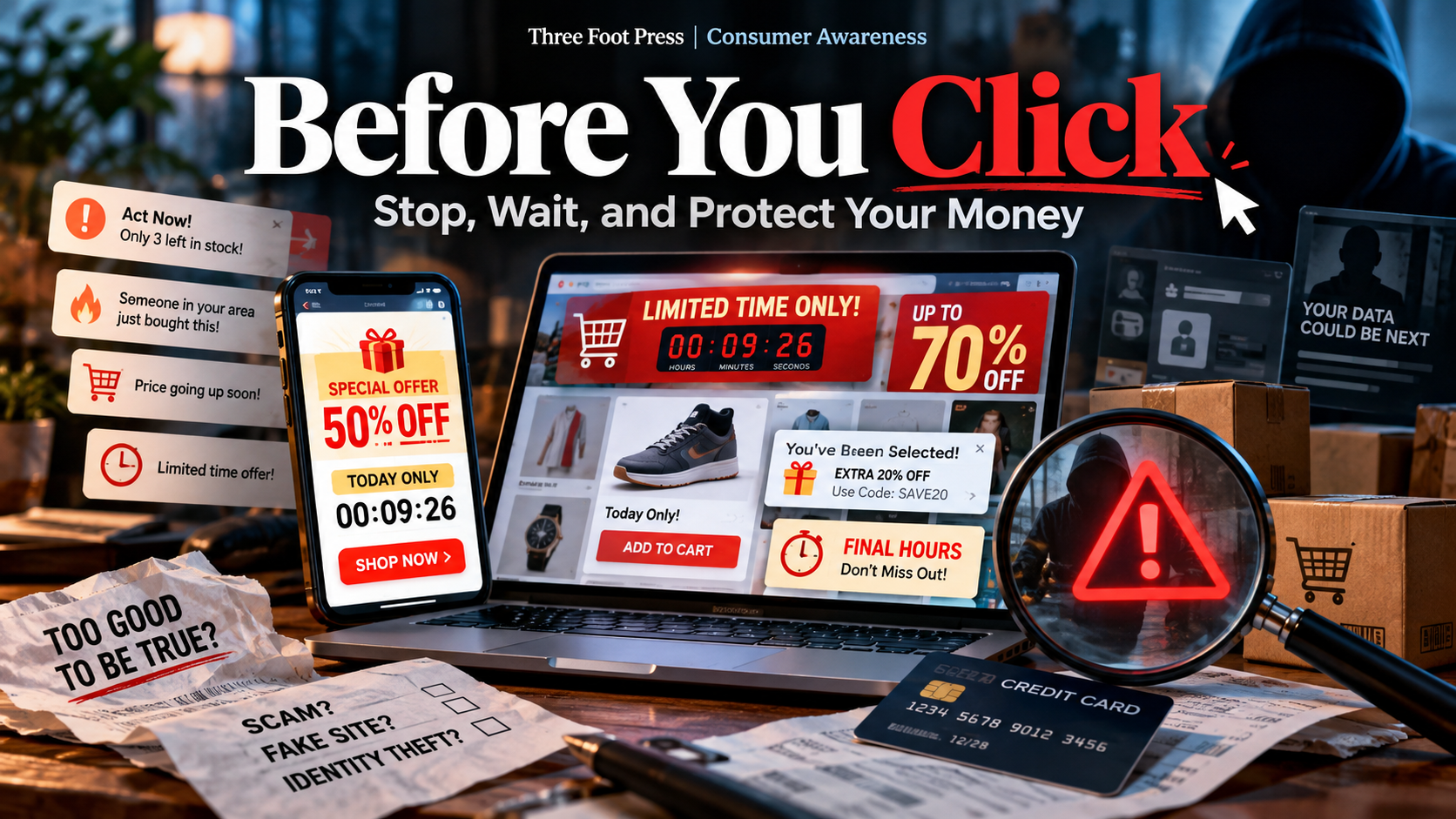
“Today Only.” “Just Three Left.” “Your Exclusive Offer Expires in Ten Minutes.” You’ve probably seen those messages, sometimes together in one advertisement. The product looks useful, the price seems reasonable, and now the opportunity is supposedly about to disappear.
Imagine an unfamiliar website offering a $79 product at a 15% discount. That’s a savings of $11.85. Is it worth rushing through checkout without identifying the seller, investigating the product, or reading the terms?
An advertisement can create urgency without creating an actual emergency. Sometimes genuine sales end and merchandise runs out, but countdown clocks and scarcity claims can also pressure people to decide too quickly. When an offer makes you feel hurried, that’s precisely when you should slow down. If the discount disappears tomorrow, you’ve missed an opportunity to spend money. You haven’t lost money you already had.
BOGO, Coupon Bundles, and Spending More to Save More
Everybody likes getting a bargain, and advertisers know it. That’s why promotions emphasize what you’re supposedly saving rather than what you’re actually spending. If two products cost $40 each and the second is half off, you pay $60 rather than $80. That’s 25% off the combined purchase, not 50%. Whether it’s a good deal depends on ordinary prices elsewhere and whether you actually wanted both items.
Online marketplaces may take the idea further with coupon bundles, credits, purchase thresholds, and rewards encouraging additional orders. Imagine receiving an offer for $100 in coupons, only to discover that using them all requires several purchases totaling hundreds of dollars. You haven’t been handed $100; you’ve been offered discounts available only if you spend more.
Once a coupon appears in your account, letting it expire can feel like throwing money away. But a coupon that causes an unnecessary purchase isn’t saving you money. If you’re buying something you need, check the retailer’s own promotions or ask customer service whether a discount is available. Make sure the discount follows your decision to buy rather than causing it.
The $5 Bottle of Vitamins That Becomes $108 a Month
Few shopping surprises are more frustrating than discovering you’ve accidentally enrolled in an expensive subscription. Imagine seeing vitamins advertised for five dollars. You enter your card information, place an order, and receive the bottle. A month later, another arrives. Your statement shows an $89 charge plus $19 for shipping and handling.
When you contact the company, you’re told the five-dollar purchase enrolled you in monthly delivery. The initial bottle was promotional, while subsequent shipments cost $108. If eleven more shipments arrive after that first five-dollar bottle, the total for twelve shipments reaches $1,193.
Before accepting any free trial or discounted introductory offer, find out whether future shipments are automatic, what they cost, when charges begin, and how cancellation works. The FTC’s guidance on free trials and automatic renewals warns shoppers to examine recurring charges, prechecked boxes, and cancellation terms.
Recurring deliveries can be convenient. Amazon Subscribe & Save, for example, can be useful for frequently purchased household items. But if you want one item, make sure you’re selecting a one-time purchase, and remember that subscription prices may change. An inexpensive trial shouldn’t quietly become an expensive commitment.
TikTok Shopping and the Seller Who Disappears
TikTok and other social media platforms can move someone from watching a demonstration to purchasing a product in seconds. An influencer shows a clever gadget, the price looks attractive, and a link promises quick delivery. But the person in the video, the business collecting payment, and the company shipping the item may be entirely different parties.
Imagine ordering a $39 electronic gadget. Three weeks later, nothing has arrived, tracking information is useless, and the seller doesn’t answer emails. Or perhaps the package contains a cheap imitation, and returning it requires expensive overseas shipping. The FTC has documented reports of merchandise that never arrived, counterfeits, and products substantially different from advertisements.
Before purchasing through a social media promotion, determine where the transaction actually happens. Buying through a platform’s shopping system isn’t necessarily the same as clicking an ad that redirects to an unknown website. Available customer protections may differ. Remember, too, that influencers may receive commissions when viewers buy through their links. Their enthusiasm may be genuine, but a paid recommendation is still advertising.
Sometimes the Product Isn’t the Scam. Your Information Is.
We tend to think of shopping scams as losing money on a product that doesn’t arrive. But some fraudulent websites may be more interested in collecting information than selling merchandise. A convincing storefront can collect names, addresses, phone numbers, email addresses, and payment details. Criminals may use stolen information in unauthorized transactions or attempts to access accounts.
Imagine standing at the Walmart checkout with toothpaste and vitamins. The cashier asks for your Social Security number, online banking password, or the one-time verification code your bank just sent to your phone. You’d immediately question why any of that was necessary.
Yet people sometimes provide comparable information to unfamiliar websites or supposed customer-service agents simply because the request appears during an online transaction. Ordinary merchandise purchases shouldn’t require banking login credentials, Social Security numbers, or one-time security codes intended to protect an account. Some regulated or financial transactions legitimately require additional verification, but that doesn’t justify surrendering sensitive information to an unknown seller.
Be cautious when an unexpected caller or message asks you to read back a code to cancel an order, issue a refund, or secure an account. If you suspect a problem, open the bank’s or retailer’s official app or website yourself. A discount isn’t worth compromising your financial security.
Credit Cards, Debit Cards, and Virtual Numbers: Protect the Money You’ve Earned
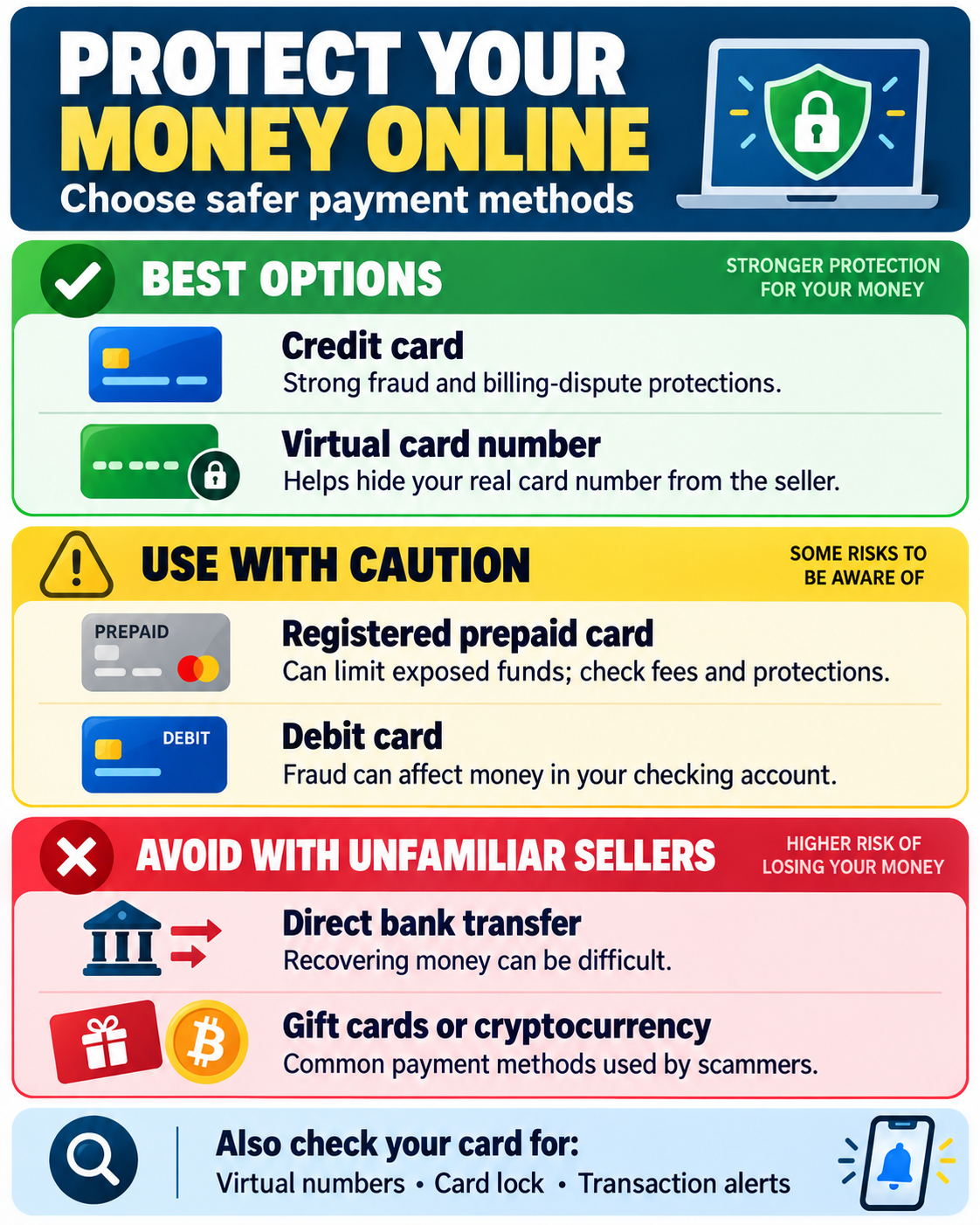
Credit and debit cards look similar, but the difference matters when fraud occurs. A debit card usually accesses money in your checking account. Unauthorized activity can reduce the cash available to pay bills while the bank investigates. A credit card ordinarily charges a credit account instead of immediately taking money from checking. Federal protections apply to both, but liability rules, reporting deadlines, and dispute procedures differ. The FTC explains the distinctions.
For online purchases, especially from unfamiliar retailers, a reputable credit card is generally preferable to a debit card linked directly to checking. That doesn’t mean spending beyond your means or carrying interest-bearing debt. The idea is to use protections, not finance an unnecessary purchase.
Virtual credit card numbers are offered by some card issuers. Instead of providing the number printed on your physical card, you use a substitute number. Depending on the issuer, that number may be limited to one merchant or disabled separately. It’s not fraud-proof, but it can limit exposure of the real card number.
Card-lock features let some users block many new transactions through the official banking app or website. If you lose your wallet or notice suspicious activity, a lock may be valuable while you contact the issuer. Previously authorized or recurring charges may still go through, and locking isn’t a substitute for reporting fraud. Transaction alerts can help you discover suspicious charges quickly instead of waiting for a monthly statement.
A reputable registered prepaid card funded with a limited amount may provide another option in some circumstances, although fees, acceptance, and dispute protections vary. Never confuse a legitimate prepaid payment card with a stranger’s demand to buy gift cards and send them the numbers. Gift cards, cryptocurrency, and direct bank transfers are especially risky ways to pay unfamiliar sellers when you might need to recover funds.
If you already have a credit card, explore your issuer’s app. See whether virtual numbers, card locks, and transaction alerts are available. Knowing about these features before something goes wrong is much better than discovering them afterward.
Keep Your Shopping Accounts Secure
Consider how much information an Amazon account used for several years might contain: purchase history, delivery addresses, saved payment methods, subscriptions, and details about gifts bought for family members. Protecting that account matters just as much as evaluating unfamiliar sellers.
Use a unique password that you don’t reuse elsewhere, and enable a passkey or two-step verification where available. Periodically review recent orders, saved payment methods, addresses, and subscriptions. Be suspicious of unexpected messages claiming a large fraudulent order has been placed and requesting a security code to cancel it. Instead, open the retailer’s official app or website and inspect the account yourself.
The same habits apply to email accounts, which are especially important because they can be used to reset passwords on other services. If a parent, spouse, or older relative needs help understanding account security, explain the options and keep them involved and in control.
The Local Store Still Deserves Your Business
Online shopping offers enormous selection, particularly for specialized hobbies and replacement parts. But convenience shouldn’t automatically determine where we spend money. At a physical store, you can handle merchandise, examine its construction, compare alternatives, and ask questions. If something goes wrong, you generally have a place to take it back.
Established retailers that also have physical stores may offer a useful compromise. Walmart, Target, Lowe’s, Home Depot, and others provide ways to order online and, for eligible purchases, return items locally. An unknown website’s price that’s $8 lower isn’t necessarily a bargain after considering shipping, quality uncertainty, and refund difficulties. Sometimes a few extra dollars at a familiar business are money well spent.
Don’t See It on the Shelf? Ask the Store to Order It
Just because a store doesn’t carry something on its shelves doesn’t mean it can’t get it for you. Major retailers such as Walmart, Home Depot, Lowe’s, and Target can often order products for delivery to your local store. Bookstores, hardware stores, and hobby shops may offer similar services.
In many cases, there’s no additional shipping charge because the merchandise arrives through the store’s regular distribution system. You may have to wait a few days, but you would have waited for an online delivery anyway.
There’s another advantage: The store handles the ordering and receiving, and you have a local business to deal with if there’s a problem. Depending on the store, you may even be able to pay with cash, including when prepayment is required, without entering your banking or credit card information online.
Before ordering from an unfamiliar website, ask your local store a simple question: “Can you order this for me?”
What to Do When Something Goes Wrong
Even careful shoppers can encounter a dishonest seller, unwanted subscription, or compromised payment account. If something goes wrong, acting promptly usually gives you more options than hoping it will disappear. If merchandise never arrives or is substantially different from the advertisement, keep the original ad, order confirmation, receipt, tracking information, and communications. Contact the seller through a verified channel, and contact your card issuer promptly if you need to dispute a charge.
If an unexpected subscription appears, request cancellation in writing and save the correspondence. Continue checking statements for charges you don’t recognize. If payment information may have been stolen, use card-lock features if available and contact the issuer. If banking credentials were exposed, notify the bank immediately and secure affected accounts.
For suspected identity theft, IdentityTheft.gov provides reporting and recovery guidance. You can report suspected scams at ReportFraud.ftc.gov. Reporting may help authorities identify patterns, although it doesn’t guarantee reimbursement. Be cautious of anyone who later promises to recover money you’ve lost in exchange for an upfront fee. Some criminals target victims again by posing as recovery specialists.
There’s no reason to be embarrassed about asking for help. Scammers invest time and money in making their offers convincing. The important thing is protecting what remains and avoiding additional losses.
Fifteen Shopping Habits Worth Remembering
- Stop and wait. If an advertisement introduced something you weren’t looking for, give yourself time before buying.
- Question extraordinary claims. Remarkable results deserve independent evidence.
- Identify the seller. Know who’s receiving your money, how to reach them, and how returns work.
- Don’t mistake repeated advertisements for recommendations. They may reflect your earlier activity.
- Use rewards wisely. Take discounts on planned purchases, but don’t buy unnecessary things just to earn points.
- Calculate actual savings. Ten cents per gallon saves only $1.50 on a 15-gallon fill-up.
- Ignore artificial urgency. A discount isn’t worth rushing into a questionable transaction.
- Compare real prices, not promotional percentages. BOGO offers and coupon bundles aren’t automatically bargains.
- Check for legitimate discounts. Consult official offers or ask the seller about available promotions.
- Read subscription terms. Make sure you’re buying one item if that’s all you want.
- Protect sensitive information. Don’t supply banking passwords or account codes for ordinary shopping.
- Use protected payment methods. Investigate credit cards, virtual numbers, card locks, and alerts.
- Secure shopping accounts. Use unique passwords and additional authentication when available.
- Check established or local stores first. If something isn’t on the shelf, ask whether it can be ordered.
- Remember that you can walk away. You don’t owe anyone a purchase because you watched an ad or claimed a coupon.
Before You Buy Anything Else
Think about the last thing you bought online that you didn’t really need. Maybe it was only ten dollars. Maybe it was a gadget that looked useful, a product promising amazing results, or something you purchased because the discount was about to expire. Perhaps it worked out. Perhaps it went straight into a drawer. Either way, consider what influenced the decision.
Was it something you’d been looking for? Was the price genuinely good? Did you know who was selling it? Or did an advertisement make the purchase seem too convenient to pass up? That’s the habit worth changing.
There’s nothing wrong with shopping online when it serves your needs. Sometimes it’s the best way to find a specialized product, save time, or purchase something unavailable nearby. There’s nothing wrong with enjoying a genuine discount or using a rewards card, either. But the decision to spend should belong to you.
A seller should earn your trust before receiving your money. An unfamiliar website should provide reasonable answers to reasonable questions. An advertised bargain should still make sense when you calculate the dollars involved. No discount should be persuasive enough to make you ignore your instincts about a suspicious transaction.
If enough consumers start asking questions, comparing prices, refusing unnecessary subscriptions, and walking away from manipulative offers, retailers will have a reason to compete on the things that matter: honest pricing, useful products, dependable service, and fair treatment. That would be good for consumers and for businesses willing to earn our trust.
So the next time an advertisement tells you to hurry, don’t let it decide for you. Close the page, think it over, and come back if the purchase still makes sense.
Stop and wait. Protect your money, protect your information, and make the seller earn your business.
Sources and Further Reading
- FBI: 2025 Internet Crime Report (PDF) — reported internet crime losses, including losses involving older Americans.
- FTC: Reported Losses to Scams on Social Media (April 2026) — social-media fraud and shopping scam figures.
- FTC: Free Trials, Auto-Renewals, and Subscriptions — how recurring offers work.
- FTC: Lost or Stolen Credit and Debit Cards — liability and reporting protections.
- Google My Ad Center — advertising personalization controls.
- IdentityTheft.gov — identity theft assistance.
- ReportFraud.ftc.gov — report suspected fraud.
Source note: FBI internet-crime figures and FTC social-media scam figures may cover overlapping losses and should not be added together. Shopping, subscription, loyalty, and rewards examples are illustrative, not estimates of unreported national spending.


